Saturday, October 22, 2005

The Future of Genetic Engineering (2005-2030)

"How neat it would be to have genetic engineering treatments to get extra eyes, fur or tentacles?", asked Conan K. Woods on wta-talk.

I am normally not psychologically comfortable to speculate too much, chiefly because I feel (perhaps wrongly) that everything was already said by someone more competent (e.g. by one of the book authors such as Kurzweil, Naam, etc.) and I will be just stating obvious. But perhaps this is due to me having read only a few of the transhumanist books. :)

Anyway, without further ado, this is how I think genetic engineering will unfold in the next 25 years.

The foretaste of things to come

First (now-2015) we will see more and more smart drugs, i.e. drugs increasingly designed based on understanding on how genes and proteins work and not just random hit-and-miss experiments with organic molecules. It will become increasingly possible to regulate the human metabolism using the THIRD way (i.e. not neural or hormonal, but artificial drug-induced way). Things like Viagra, working drugs for losing (not gaining) weight, nootropic drugs, etc.

Then (2015-2025) we are going to see first health-related genetic modifications. As e.g. Naam describes in his book, there are several ways to modify ourselves - inject the protein (drug - see above), add the DNA into the cell (noninsertional vectors) or into the nucleus (insertional). By that time we will strongly feel the fallout from the Human Genome project, understanding a signficant part of the complex genetic chemistry. First we are going to change the DNA to fix the health defects, removing bad genes or fixing them.

At the same time we will have genetic treatments in competitive sport (Olympics) to enhance the strength, endurance, etc. Some say that first such treatments are already being used. Each next Olympics will have more and more and by 2016 a very large portion of athletes will be using some form of genetic enhancement.
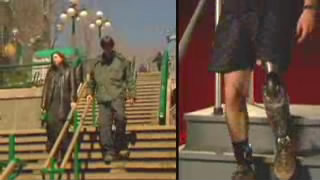
Ossur bionic leg (video)

By that time (mid-2010s) we will have some cyborgisation in healthy humans going on. Chips for interacting with the electronic environment, some enhanced senses (e.g. cochlear implants for healthy people). Enhancement surgery will be growing in popularity (things like LASIK, muscle surgery, lots of cosmetic surgery and a bit more advanced stuff). The "traditional" body modification techniques will be gradually improving. Everything that is cool today will be already passe and retro. Hard to predict these things, since they are irrational and random to a large extent like all fashion is. But one may speculate about subdermal displays, limited neuro-electronic connectivity (i.e. "implanted remotes"). Disabled people will have their artificial hands, legs, eyes and stuff in increasing numbers. But we still won't see genetically modified people with tentacles, except in a few freaks, like the leet body modders today (however, even those would probably opt for surgery + drugs, not full-scale GE).


Real-time avatar face modification (video)

Starting from about 2015 we will spend more and more time in both virtual and augmented reality. We will be more and more comfortable with modifying our appearance in arbitrary ways, spending time in animal bodies (even though only virtually), etc.

By, say, 2020 we (at least the early adopters, not luddites) will be controlling our metabolism artificially a lot (using a combination of implanted automatic smart drug-release devices and genetic therapies). There will be a few cases when humans will be enhanced significally changing their genetic code, when this can be done in a very safe manner and without side effects (this might come from one of the sports modifications). The parents will have great freedom in defining the DNA code of their kids to get rid of all bad stuff and ensure that good stuff is there, but no fins or fur yet. We will also have many artificial parts and will spend a lot of time in virtual worlds.

The onset of extensive genetic engineering

Around 2020-2025 we will see the spread of biotechnologies to the general population. We will also have desktop fabrication labs by then (and robots), some pretty useful (but not fully mature) nanotech (to compliment the biotech that we are talking about). We will have some good AI (but not human-level), so a lot of R&D will be possible to do using existing software. Software methodologies will be more advanced than today, so ordinary people will be able to get digital designs for a bio-lab, assemble it using their (may be not personally owned) desktop fab lab, get the information databases with genetic and other biological information and synthesise the DNA.

There are likely to be some regulatory issues by than. Both scaremongers and responsible scientists/politicians will demand some control mechanisms and some will definitely be established, but we can also expect bio-hackers (and pirates) to emerge. There will obviously be a gradient - if some people are doing legit body-modifications (like people in tattoo/piercing parlors today), they can add a bit of illicit modifications, provide access to illegal drugs (controlled substances) without prescriptions (like offshore Internet pharmacies today), etc. This may end up looking a little bit like the cyberpunk predictions (e.g. traditional Gibsonesque cyberpunk).

In 2025-2030 people will start to notice the exponential technological growth. Kids born in 2010 will be getting through their teenage phase (modified using mind-enhancing drugs, but not enough to turn them into obedient zombies). They will probably be the first to use the technology in radical ways. The transplantation industry would be mature by that time, with millions of transplantations performed every year - cloned parts, xenotransplants, artificial organs, etc. Stem cells would also be used to grow new organs (in vitro and in vivo). So it would be quite easy to do heavy cyborg and biological body-mods with little risk (and almost zero risk of serious complications that can't be fixed). As much as I am uncomfortable with that (today), more and more people will be experimenting with heavily modified bodies. Genetic engineering will be used in conjunction with surgery. We will also have the ability to direct body reconstruction - first selective apoptosis, then generation of stem cells and regrowth of the organs/tissues. This will obviously first be used for corrections, but eventually for rebuilding the body for other reasons.

A mermaid (from Cross Genetics)

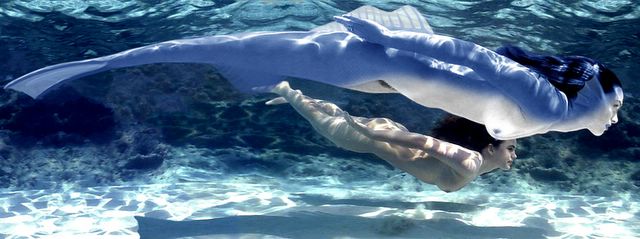
By that time technologies for genetic engineering will be widespread and accessible. Software products would exist (not in the form of products, but downloadable routines, AI modules) that can be used easily. By 2030 most people will have the ability to design new organisms from scratch and change their own bodies at will. My imagination is betraying me a bit, but when walking (or otherwise moving) on the street (or the future analogue of it) you will see people of different colours (including pink, orange and striped yellow-green), people with fur, people with animated skin, people with various additional parts (combs, spikes, etc.) added for aesthetic reasons, people with various face adjustments ("unnatural" eyes, nose, lips, teeth, etc.), people with parts of them resembling animal parts (feline eyes, etc.).

By that time the society will likely change enough to make these things not only more acceptable, but in a sense expected. Mind-enhancement techniques, significant social changes will mean that there won't be conservative job-places that don't let you come to work with wings and horns. Many people will not be working in the traditional sense, but living life in more creative ways, while the society/nature supplies them with necessities.

The precise nature of the future society in regards to the look of its members will depend on an unpredictable factor - the relative success of different development approaches. It is clear that virtual reality, cyborgisation and genetic engineering will all provide almost unlimited possibilities for human expression. But which of the three methods will be more populat (at certain point) is hard to predict, because it depends on which one will be more advanced, more efficient, safer, cheaper, more available, easier to use, etc. It is likely that all methods will complement each other to some extent, but personally I am not ready to predict with certainty whether the society of 2030 will consist mostly of people inhabiting VR worlds, robots walking the streets or mutated chimeras flying and swimming around...

Well, that was me imagining what the future will be like. Stay tuned (or not) for the visions of life in the world of mature nanotech and life after uploading.

Comments, criticism and discussion obviously welcome.

This text can be edited at the Future Wiki

Thursday, October 13, 2005

Children of the Secret State - North Korea

"Children of the Secret State" (ed2k link) is a propaganda movie made in 2000. The film was mostly likely planned by psyops specialist and is a good example of the information warfare campaign waged against North Korea. But North Korea is not the only victim — we all are the victims too when we are led to believe lies and fabrications. I believe it is useful to train yourself in critical thinking skills and to try to build up some mental defences against manipulation. That's why I wrote this commentary.

This review present an analysis of some of the scenes of the film. My conclusion is that this film is an attempt at manipulating the viewer to believe that North Korea is a horrible place, its leader Kim Jonh Il is evil, his regime is brutal and the economic system has collapsed. But a careful and impartial viewing of the film with a critical eye and constant online doublechecking demonstrates that there is very little in this film that should be believed. In this film no evidence was presented, although the authors tried extremely hard to make it seem as if such evidence was in fact shown. And I have no doubt that most viewers believed that it was.


North Korea pioneers

The film starts with the video of hungry child orphans (still, apparently looking healthy enough) that is going to shock everyone, especially combined with the matter-of-fact narrative. The narrator claims that 3 million people died from hunger. Another claim is made - that UNICEF estimated there are 200000 orphans in the country (BTW, don't trust all statistics about orphans, lies and manipulations are an ever present danger). It's awfully hard to find data on orphans in the US, but it appears to me from what data is available that the number of children without parents as a percentage of general population is about the same in the US - about 1%.

The population of the North Korea is 23 million, BTW, the population growth rate in 2005 was 0.9% (0.38% in South Korea), life expectancy 71.73 years (75.82 in SK) and infant mortality 24 deaths/1000 live births (7 in SK). While we are at it, the literacy rate is 99% (compared with 97.9% in SK). But everyone is still shocked, that's expected, even I am. However, I now start to think what they are trying to say, whether I am being manipulated and how this agrees with other things I know.

OK, we move into the capital. The presenters never ignore a chance to manipulate the viewer. From mentioning the Big Brother to emphasising the censorship. First they are trying to make a ridiculous point by implication. They present the visuals as if the whole capital is essentially fake and everyone else lives in poverty and hunger in secret towns. Well, to begin with, that doesn't make any sense. Why would the North Korean government want that? Do they really care that much about impressing foreign journalists who manage to enter the country despite the apparent restrictions? That doesn't make sense (since they actually try to prevent foreign journalists from visiting).


Pyongyang street

Then every image is twisted as the presenters need. For example, there is no one in the street in the middle of the day, there aren't many other guests in the hotel and there are few cars on the streets. Somehow all this proves that North Korea is bad. But, of course, there is no one in the streets - everyone is working. Then the hotel is empty, because it was designed and built in a different time, but it turned out to be a mistake and there aren't many foreign tourists today. And there aren't many cars, but there is examplanation - cars are too expensive, not very efficient and North Korea is short on fuel.

The fact that the journalists are well fed is somehow a proof of how evil and corrupt the regime is (if they weren't, doubtless they would use this as another proof of the hunger). Supposedly, one can't find such a stark contrast in the US, no way. But filming a dinner in an expensive Manhattan restaurant and some child suffering from hunger (there are millions of those in the US) doesn't enter the minds of the journalists. Then we hear some unsubstantiated claims that all well-fed children rehearsing for the parade are the children of the elite. How do they know it? Of course, the American viewer is unlikely to question the words of the journalists.

I mean, you don't need to go far. Russia is no longer a totalitarian state, but you can find children, who are drug addicts, alcoholics, homeless, orphans, prostitutes and theives. How are isolated facts (even filmed on video) a condemnation of a country? Also, how is it a fault of the government, when the people living in that town/village do not help the kids?


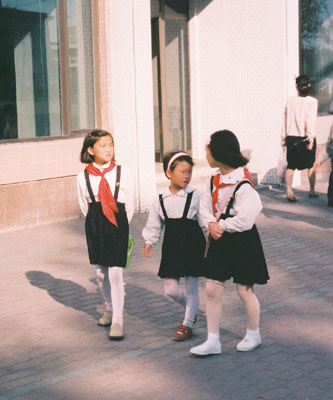
Pyongyang Palace of Pioneers and Children

Then the Children's Palace. Here even the fact that there are apparently some children who are not hungry presented as an evil deed of the Dear Leader. He is told to have "decided to favour these children". I wonder if the journalists have any ideas of why exactly did he make this decision. Does he have anything against those other, hungry children? Does he have an evil plan?

The journalist is near the Chinese border. He is allowed to drive there in a car and he has to exaggerate the dangers. If they spend too much time in one place, they may be interrogated by the police. Well, try to spend too much time in one place next to the Mexican border. I bet you would be interrogated by the police as well. It's illegal to film at the border (like in many other countries), but the brave fighters for freedom managed to do it. Apparently, they filmed some border guards, who appear to be guarding the border. Clearly, that is some evil North Korean plot. Is it possible that they are looking for possible violators, who intend to cross the border illegally? Well, I am sure no civilized nation would ever do such a thing. Certainly not the United States... Well, pardon me my sarcasm, but insinuations are everything. It is possible to film perfectly legitimate activities, but if they are in North Korea, they suddenly become menacing, dark and evil. Such as border guards hiding in bunkers.

Then we get a lie about refugees facing execution after being returned from China to North Korea. There is no evidence, just hearsay. Signs such as "Never help an illegal alien" are presented as something horribly wrong, even though (no sarcasm this time) most countries have some regulations against illegal aliens and helping illegal aliens is a misdemeanour in many countries as well (North Koreans are facing a fine, which, supposedly, is horrible).

We are in China now. The woman buying some foodstuffs who is looking strangely at the foreigner filming her is presented as visual evidence of "paranoia and suspicion" filling the air. Perfectly ordinary images of normal life, combined with a alarming music reinforce the feeling that the air is indeed filled with paranoia. It might be the paranoia of the journalist, however. Then we have one interview, where we are not told anything substantial except that some people died from hunger.

OK, we're back. Here a child repeats to the journalists some hearsay about cannibalism. I don't think this can be considered evidence, but the guy appears to have some very lax journalistic standards. Some child drawings and "a friend told me he saw" are now considered sufficient evidence.

OK, now we are shown some Chinese girl eating some soup. We are told that "these children are well-fed". This time we aren't told that Chinese leaders "decided to favour these children", no, it's implied that there is no hunger in China. But, as a matter of fact, China (the "nice" neighbour of North Korea) is still home to the world's second largest number of undernourished people after India. According to some estimates, all over the world over 1 billion people are chronically undernourished. 20 millions die each year from hunger and its effects (almost the population of North Korea). And yet the US and its venal journalists chose to pick on North Korea. Even though, the United States isn't without its own share of problems... Particularly, 3.5 million people are homeless and 35.9 million people live in poverty. They don't seem to notice the mote in their eye...

It's part three and franly I am tired. It's not easy to consciously withstand attempted psyops. But I can't leave the task unfinished, I will have to endure the lies and deceit for 20 minutes more.

We are shown some positively chubby North Korean children, but the disquieting music somewhat compensates for that. We feel that all is not well. We are shown something which is claimed to be a "ghost town" (shot from the nearby mountain). Then we are informed that "industrial activity has ground to a halt". We are made to think that this isn't an exaggeration, but a statement of fact - this is accompanies by the image of the supposed "ghost town". Of course, simple logic dictates that it's impossible for all industrial activity to stop in a country and even the CIA factbook admits real GDP growth of 1% in 2004. But who needs logic in a times like this? Then we hear an account of a well-dressed "escapee" from the town, who tells us that the town's poor stole the equipement and parts from the factories and sold them... The question of whom did they sell factory equipment in small town in a country with a planned economy is not discussed, perhaps, for the better.

We are shown some more children and told some more stories about hunger.

Then a random guy tells us about growing opium. There are some links online that support this claim, however, they all tend to rely on people who make questionable claims such as "Ninety-nine percent of their factories are not operating"...

OK, we are going to South Korea now. In passing we are told that one in every 100 North Koreans is in prison camps. We are not told that 1 in 142 USA residents is in prison as of 2002. One in a hundred (if accurate at all) doesn't sound that bad now, does it? Anyway, images of capitalism (skyskrapers, well-dressed people, etc.) demonstrate that South Korea is clearly a better place.

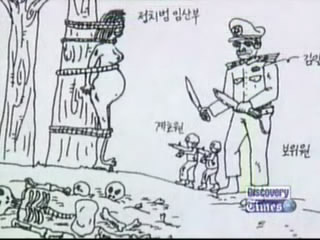
Then we hear a story of a former guard, which (if genuine) does make a point. What is happening in the camps, if true, is brutal and horrible. However, no other evidence is presented and it's extremely easy to exaggerate (or downplay) the reality.


Who needs photos when you can draw your evidence?
I am going online to look up some information related to aid. In one place we find that "An estimated 200,000 to two million people died in the famine." Well, that's bad, but that's not 3 million people claimed in the beginning of the program. It does confirm the fact (which no one really doubted) that a large fraction of children ("62 percent of children under the age of seven" in 1998) is chronically malnourished. Thanks to the aid, the "chronic malnutrition has dropped to 21%" by 2002. However, in order to blackmail North Korea over its nuclear program, the US and Japan severely decreased their aid, knowing well what would be the effect of it. The film claims that the US didn't do that.

We are told that North Korea receives more food per capita in aid than any other country. Well, it appears to have received about 30$ per person served per year (in total), which is about average of what WFP does... Other sources, while providing some criticism of North Korea's handling of aid, disagree that it's a deliberate diversion and say that the problems are not as significant.

We see the black market, but the opinion of experts is that this diversion of aid doesn't affect the situation that much.

Again we are shown some children. This time the journalist claims "but children go empty-handed as these pictures reveal". I don't know what these pictures reveal, other than blatant attempts at manipulation. Does he claim that all children are denied food in Korea according to some evil plan? Does he claim that Korean government actively discriminates against children? He is trying to mislead. The footage of children he presents is biased so much as to be almost useless.

Well, the film is over. What can we say? That Discovery, Channel 4 and the journalist are manipulative? Yes. That people are being systematically mislead about North Korea? Certainly. That people in North Korea suffer from hunger? Yes. That Kim Jong Il is evil, his regime is brutal and the economic system has collapsed? That's not so clear. In this film no evidence was presented, although the authors tried extremely hard to make it seem as if such evidence was in fact shown. And I have no doubt that most viewers believed that it was.

See my previous post about North Korea: Remembering the Revolutions

The photos are from a report of a Russian visitor to North Korea, who saw a very different picture while travelling around the country.

Wednesday, October 12, 2005

NISTEP 2030 forecast

The Japanese National Institute of Science and Technology Policy (NISTEP) runs a technology foresight project every five years, looking 30 years into the future. The last such exercise was carried out in 2000, producing the report Future Technology in Japan toward the Year 2030 (download).

The 2007-2030 timeline in this report is one of the most methodologically sound.It was produced in a large Delphi study involving several thousand experts. Past NISTEP reports had predictive accuracy of 60-70%.

But the forecast shies away from advanced transhumanist technologies and looks rather traditionalistic and non-controversial (this is not to say these were not included among the original topics, but that they were not considered important by experts and so less attention is paid to them).

  • The report barely makes a passing mention of nanotechnology: only one item — "Practical use of single atom/molecule manipulation techniques as methods for device fabrication and gene manipulation.", scheduled for 2015, is included.
  • Artificial intelligence is apparently ignored. It's mentioned in only one topic: "Development of software (expert systems) capable of completely taking the place of specialist professions such as judges, lawyers and patent attorneys.", is slated for 2025 and is deemed unlikely to ever be realised by 48% of respondents.
  • Brain enhancements are mostly ignored, despite predictions of understanding much of how the brain functions between 2015-2025.
  • Despite listing a plethora of medical advances, the report says nothing about possibilities of life extension, reversal of aging and achiving immortality.

One non-traditional area (although it is much more traditional for the Japanese) that features prominently is robotics.

A forecast that ignores nanotechnology and artificial intelligence — undoubtly the key enabling technologies for human transformation in the coming decades — can not be deemed accurate and is at best extremely misleading.

Edit this post at Future Wiki

Sunday, October 09, 2005

My Personal Answers to 15 Global Challenges

My Personal Answers to 15 Global Challenges.

1. How can sustainable development be achieved for all?
By making technological development sustain itself and not rely on frail Earth's ecosystem.

2. How can everyone have sufficient clean water without conflict?
With technologies, such as nanotech, that will be widely available by 2015-2020.

3. How can population growth and resources be brought into balance?
They will never be. Population growth simply won't catch up with the exponentional growth of resources provided by the supertechnologies such as nanotech and AI.

4. How can genuine democracy emerge from authoritarian regimes?
We need to realise that "genuine democracy" is a fiction and that democracy is simply one of the ways to structure the society, worthless by itself. Authoritarian regimes usually have a valid reason to be such.

5. How can policymaking be made more sensitive to global long-term perspectives?
By eschewing democracy of uninformed idiots and encouraging an autocratic government of educated technocrats.

6. How can the global convergence of information and communications technologies work for everyone?
As a result of people, companies and governments working on this issue. The digital divide is unsustainable and is easy to bridge - all it takes is work.

7. How can ethical market economies be encouraged to help reduce the gap between rich and poor?
By replacing them with planning, taking the profit motive out of the economy and nationalising capitalist enterprises.

8. How can the threat of new and reemerging diseases and immune micro-organisms be reduced?
By spending more on medical and biotech research and controlling big pharma better.

9. How can the capacity to decide be improved as the nature of work and institutions change?
By promoting intelligence, rationalism and science, by destroying the plutocratic elite and by instituting public control of the media.

10. How can shared values and new security strategies reduce ethnic conflicts, terrorism, and the use of weapons of mass destruction?
By disarmanent of the United States, by stopping the exploitation of the third world and by building strong national economies there. Shared values can't do anything if you don't share the bread as well.

11. How can the changing status of women help improve the human condition?
By having them do some work more useful than cooking and doing laundry, perhaps?

12. How can transnational organized crime networks be stopped from becoming more powerful and sophisticated global enterprises?
A better question would be how can powerful transnational global enterprises be stopped from becoming more like organized crime networks?

13. How can growing energy demands be met safely and efficiently?
By using solar and fusion power and by severely restricting private ownership of cars, while building better public transport systems.

14. How can scientific and technological breakthroughs be accelerated to improve the human condition?
By spending more on science, promoting future-oriented thinking, taking public control of all media and starting intensive atheist and rationalist propaganda.

15. How can ethical considerations become more routinely incorporated into global decisions?
By replacing the plutocratic capitalist society with meritocratic socialist or communist society, so that the leaders are more motivated to work for the benefit of all people.

Friday, September 16, 2005

Connections and Knowledge Web

There is an amazing BBC series Connections by a famous science historian James Burke. The films explore how various discoveries, scientific achievements, and historical world events have linked together over the centuries to bring about particular aspects of modern technology. The series (40 films in total) are the most delightful and accessible approach to the history of the world and its' sciences since the Cosmos series.

Then I was researching information about the Connections series online and accidentally stumbled on a link to KnowledgeWeb. I was amazed to learn that such project already exist, because I dreamed about something like it for a long time. I am extremely interested in the development of science and technology (goes in the family, my father's doctoral thesis was done in this field) and was envisioning a tool similar to K-Web for a long time. Now I found it. :) Have to find whether it's actually useful (i.e. if custom content can be added there).

Monday, September 05, 2005

From custom manufacturing to universal assemblers

Using custom manufacturing a Wired journalist with no design experience designed his own an electric guitar in eMachineShop and had the parts printed to spec.

Gershenfeld, director of MIT's Center for Bits and Atoms, makes a reasonably good case that soon every house will have its own personal fabricator. He has already taken an important step - he has shrunk the personal fabricator down to a single room's worth of off-the-shelf tools, all of which are available right now.


Custom manufacturing in a fabrication lab -

The CBA fabrication labs are already used to produce peculiar one-off individualised devices, such as GPS-enabled tags for sheeps, electrode-driven device to measure the fat content of milk, motion-detector security system to protect a personal diary.

Current precision of cutting (Epilog Legend 24TT) and milling (MDX-20) tools is about 25-50 microns.

Further path:

  • miniaturise all components of a personal fabricator
  • combine it all together into a set of compatible devices
  • add some robotics so that manual labour is not needed for assembly
  • make it use cheap standard raw materials and parts
  • simplify, make more user-friendly, interface with an online library of designs

OK, that doesn't actually sound too far-fetched, but would quickly make the fabricators ubiquitous and extremely useful.

Next steps:

  • continue the minaturisation
  • replace the components one by one with nanotechnology based machines
  • optimise the design of a fabricator to make sure no space/matter is wasted


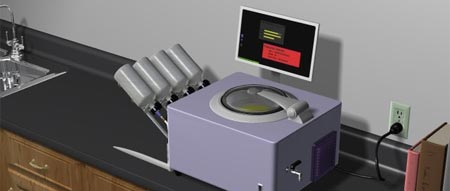
Tabletop nanofactory

Now you have a nanofactory (vision, 60Mb video). This is already functional nanotechnology and will set off the final stage of the revolution (super-exponential computing power growth and the singularity).

Further steps:

  • break down the nanofactory from a single machine into small parallelised units, each capable of producing small nano-objects to spec
  • make the units as small as possible

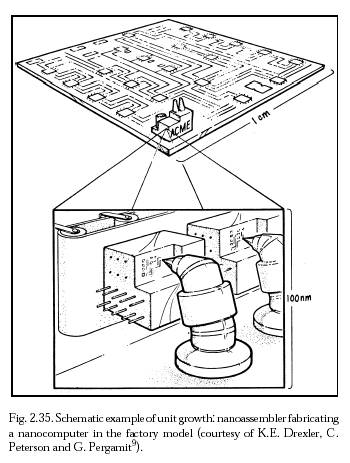
Finally, we have a nanoassembler.


Nanoassembler

Final step:

  • make it possible for this assmbler to make copies of itself

We have a unversal self-reproducing nanoassembler. Finally an end to material scarcity. This would signify final liberation of the man and the control of mind over matter. This is a posthuman level, where turning all dumb matter into smart matter is finally possible.


Nanoassembler making nanocomputers in a nanofactory

Edit this text at Future wiki

Thursday, September 01, 2005

Fake diplomas

Just stumbled today on the site of a genuine looking company (in Russia) that provides fake diplomas and other papers of all kinds. Looks extremely professional and reliable (as far as you can judge it from their site). Call +7 (901) 372-31-14 to order anything from fake diplomas (registered in university's archives) to a passport (domestic or foreign) to Council of the Federation (Russian Senate) Member's certificate.

That's neat. The only hope for preservation of privacy and freedom from totalitarian government surveillance may come from professional criminals (as one can also see from countless sci-fi movies such as Johnny Mnemonic, etc.).

Sunday, August 14, 2005

Magic on TV

I don't usually watch TV, but today I was asked to record a show on a VCR so I was just randomly flipping through the channels while the casette was rewinding. I can't believe our TV has already sank that low...


I can feel their magic power

On the left is a fat Georgian magic healer. In the middle a hippy-like clairvoyant that looks like a horse. And the host on the right. I can't believe that anyone is falling for that shit, but apparently some do, they all looked serious. Unbelievable, now I want to gouge my eyes out. I think I better to go read randi.org to ease the pain a bit.

Monday, August 08, 2005

Seeing the world

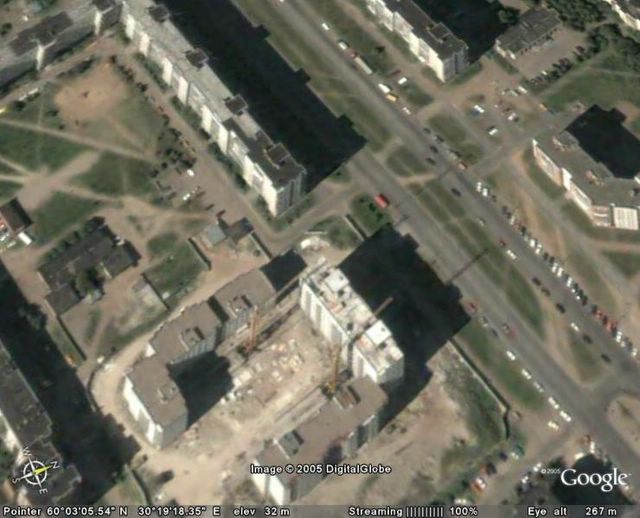
Australian company Astrovision announced plans to provide real-time satellite video (first of Australia) with resolution down to 250 metres.

"Users [will be] able to select destinations and zoom in to as close as 60 metres and to as far out as 57,000 kilometres. ...Astrovision plans to launch five satellites to provide coverage of the globe over a decade."

Do you know where is this place?

There are already thousands (tens of thousands? hundreds of thousands?) webcams everywhere in the world, providing 24-hour live feeds of what is happening "there". Get the feeling of it with this nice artistic piece - Netlag.

In the future more and more information about the world will be available to us indirectly (i.e. we won't see it with our own eyes) and this information will be multi-facetous, instant, customized and interactive.

In a sense, this is about gradually become omnipresent. Ultimately every human will be able to instantly know everything that is happening anywhere on Earth, know about every raindrop falling, every leaf trembling. Just like gods. Isn't it cool?

Posted to Future Wiki

Sunday, August 07, 2005

Animusic

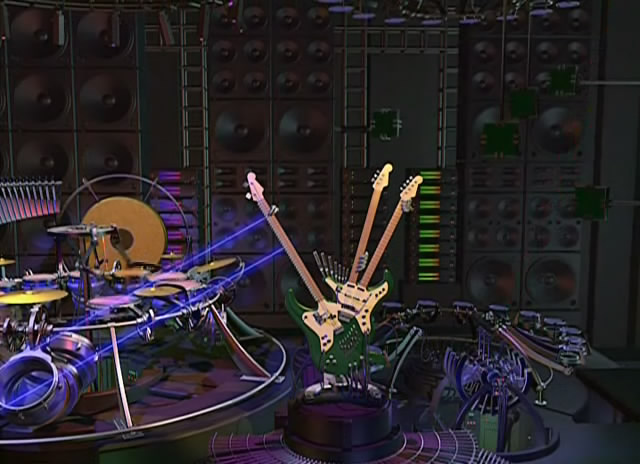
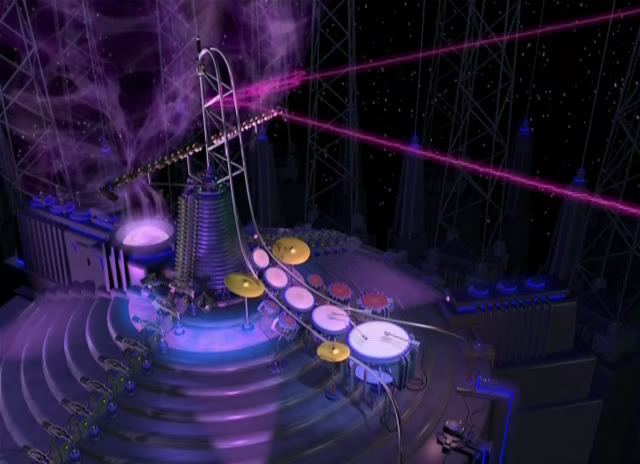
Just watched and listened to the Animusic - a video music-driven computer animation. It's a 30-minute video, with seven different animations.


Future Retro


Harmonic Voltage

It's very original, both music and animation are very good. Short clips can be downloaded from the Animusic website. ATi has a real-time version of "Pipe Dream" and the video version. The DVD can also be downloaded from eDonkey network.

Saturday, August 06, 2005

Two types of change

While reading one emotional overview of the trends in the ICT market, it dawned on me that the constant change everyone keeps to be talking about for the past few decades is not monolithic.

There are two distinct components in it.

  • One is the squabble between the competitors in the global marketplace. The outsourcing, the competitive threat from emerging markets of China and India, the need to serve the needs of diverse international customers. This kind of stuff. You can no longer be safe, no matter what your business is, and you need to change. But at the core this is essentially a pointless zero-sum game that noone really benefits from. When Walmart forces you to squeeze out every penny from your suppliers, the economy overall suffers (or gains only marginally). When Procter & Gamble introduces another "NEW!!!" shampoo, customers' lives don't really change. Yes, the market economy causes everyone to strive for perfection, but the difference between perfect and the "good enough" is not really worth it.
  • Much more important are the constant technological improvements - the never-ending unstoppable progress of science and technology. This is what makes our lives today so much better than 100 years ago, not competition between global oligopolies. This change benefits not the competition, but from cooperation. Incidentally, this is what will bring us the Singularity and other transhumanist goodness. It doesn't really matter who makes the mobile phone handsets - Nokia or one of its new Chinese rivals, what matters is that overall tehcnologies improve and make better products possible, regardless of who is in charge.
The potential of business innovations isn't zero, but it is often overestimated. Yes, you probably can shave off a few percentage points from your costs using outsourcing, an ISO 9001 quality program, new staff motivation technique, management training in change management or some other snake oil of the day. This may even help you beat your archrival (or, more likely, maintain the status quo). But it will all be forgotten in a decade. The real, long lasting changes and qualitative orders-of-magnitude improvements come from changes in underlying technologies, not business techniques.

Tuesday, August 02, 2005

Automatic context sensitive search

I just came across an amazing application, Watson from Intellext. This program automatically searches online for content relevant to documents that you are working on. It supports a variety of Internet sources and it seems to be possible to add more. Right now it only supports Microsoft Office programs (Word, Powerpoint, etc.) and only English language, somewhat limiting its usefulness, but when it can be used, it's great.


Watson gets the keywords from the document and searchs for them, showing the results in a side panel


The results are surprisingly relevant and often very useful

It saves you the hassle of carefully thinking about relevant search queries. The document you are editing becomes one big search query and the results (a few hundred links, usually) come almost instantly. So far I have only tried it on existing documents, but it should be interesting to try to use it while writing a new document, augmenting my knowledge and memory with the power of the Internet. :)

Obviously, in the future automatic context-sensitive search will become much more common. Computers will be presenting us with hints, ideas, reminders, based on what we are doing, reading, talking about. The amount of available data, including our photos, e-mails, posts, conversations, etc. is growing very fast, as well as the amount of relevant information online. In the past it made sense to perform research (originally a literature search, later a google search) before writing a paper or preparing a presentation. But increasingly this becomes redundant and useless, as the amount of useful and relevant information often far exceeds our need in it.

So it makes sense to pay less attention to getting all the information. The computer should just give us something and we will use it. This is how our memory works - we are not trying to produce a perfect recollection of our past actions or of school knowledge that we acquired - we simply use what our subconsciousness gives us. A good illustration to the expected future of search is in Charles Stross's Accelerando, where search agents are running on human exocortices.

Thursday, July 28, 2005

Caracas

After returning from the Canaima I had about half a day to have a walk around Caracas.

My photos on Flickr: http://www.flickr.com/photos/91822944@N00/tags/caracas/

Tuesday, July 26, 2005

Monday, July 25, 2005

Canaima National Park

Then I went to the Canaima National Park, which is most famous for the Angel Falls, the highest waterfall in the world (almost 1 km high).

My photos on Flickr: http://www.flickr.com/photos/91822944@N00/tags/canaima/

Sunday, July 24, 2005

TransVision 2005

On July 22-24 I was at the TransVision 2005 conference in Caracas, Venezuela. The conference is the main annual transhumanist event. This time it was organised by the Transhumanist Association of Venezuela and the World Future Society Venezuela. The topic was "Towards a New World: Better, Longer and Healthier Lives for Everyone." It was an amazing opportunity to socialise with people, who share transhumanist ideas and are not freaked out by them. A nice change indeed.

My presentation was entitled "Predicting mid-range global futures" and was mainly concerned with mocking futurists for their pathetic attempts at peering into the future. It was a hoot. :) Get it here: http://danila.spb.ru/papers/transhumanism/Danila TV2005.ppt. I presented before the Closing address by Nick Bostrom, but apparantly managed to make quite an impression on the tired delegates. It wasn't particularly controversial, but it was very direct and sincere at demonstrating why some of the existing "approaches" to predicting future are worthless. It was also quite emotional. :)

The hotel sucked and we couldn't really get out into the city much, since every Venezuelan seemed bent on telling us how dangerous it is in the city. Fortunately, the conference itself was quite interesting, with the majority of the talks being rather good (only 2 or 3 were complete content-free fluff) and there wasn't much free time anyway. Kudos to organisers for pulling it off.

Links:

Tuesday, July 12, 2005

Getting things Done

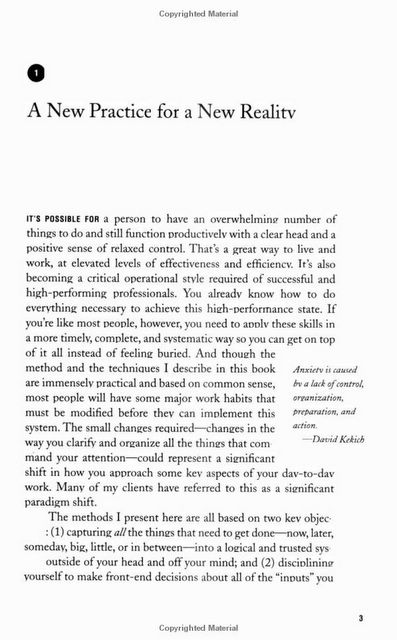
Finally, I succumbed to the exploding meme of GtD. I downloaded the book and will definitely start to implement this system in my life. I can already, by the 20th page of the book see how this applies to me, how the problems that I am facing can be probably solved using this methodology and how this is extremely relevant for me today. Was it a mistake to ignore the gtd acronym for several months? I don't know. But right now I seem to have the tools that I need - Note Studio for Palm looks perfectly adequate, in fact, more than adequate. Let's try and see.


Cover and excerpt from "Getting Things Done"

Great, after reading Steve Pavlina's article "Overcoming Procrastination" I realised that my problem with procrastination is caused by the overwhelming scale of the projects due. However, Steve did not offer a good practical solution to that that could be actually used. Neither did many other articles and ideas - a complete and total system was missing. It seems that GtD is exactly such system.

Reading Mapping the Mind and listening to Biology And Human Behavior lectures made me better appreciate the metaphors that David Allen is using. When he talks about RAM in our brain, there are very real and tangible arrays of neurons that are firing in complex patterns, remembering something (what needs to be done) and reminding our conscious selves about it. May be they not so much use the space (after all, I doubt that all those things are stored in working memory), but they use the focus. They constantly activate the central processor area and place themselves in the working memory.

I wonder if my interest in getting OneNote, FreeMind and writing^H^H^H^H^H^H^Htyping things down was caused by the pressure from undone things, the subconscious desire to get them out of my mind... But that's only half of the story, the real deal are the actions - that's what GtD is about. This will certainly help me maintain my social life, keep up with the correspondents, etc.

This is really a great book and a great methodology. It would be an oversimplifcation to say that something is "the key" to it, but the emphasis on defining and choosing appropriate actions at appropriate times is clearly very important.

/me digs deep into "stuff", while following the magic GtD flowcharts.

OK, I spent most of the day implementing the GtD system. First, I was surprised how easily I agreed to make (or pledge to make) significant changes to the way I organise myself. The system seemed extremely logical and as easy to use as possible. Clearly, it takes into account the psychological aspects of how we deal with things and the benefits are there. I processed most of the stuff that was lying around loose, which there wasn't too much of, actually. I created appropriate categories for managing the actions on my Palm and started to populate them. I think I will need to spend some time working on this tomorrow and then on my Moscow trip as well. I hope it will help me actually start doing things.

Sunday, July 10, 2005

Spread of meta-knowledge

It's amazing how much meta-knowledge about self-organisation and everything else is available online and how popular it is. 43Folders, Getting Things Done, Personal Wikis (including those running on Palms), Life Hacks, etc. All these techniques are invented, developed and popularised on the scale of a few months, thanks to blogs, wikis, social bookmarks and other social software. Good ideas flourish, get supporters, developers, evangelists, etc. Companies and FLOSS developers quickly roll out software incorporating these methods and soon these new technologies are used by millions. Obviously, such rapid dissemination of new knowledge would have been impossible just 20 years ago without Internet. And yet, we are just getting started. Wonderful times are ahead.

Thursday, June 23, 2005

The greenery of Saint-Petersburg

Living in a big city can be really stressful sometimes. Fortunately, Saint-Petersburg has something to combat the stress, namely the great parks, avenues and embarkments.

St. Petersburg is the greenest of Russia's major cities. The statistics are impressive: Over 200 parks and gardens, plus over a thousand tree-lined streets and more than 700 leafy squares; and more than 2,000 hectares of greenery in total - or more than 56 square meters for each of the city's more than 4.5 million inhabitants. (more info)
If one is not confined to the office, spending a few hours with a book (or a PDA) in a park can be really invigorating. My only complaint is the noise pollution from the cars - you can't get away from it.


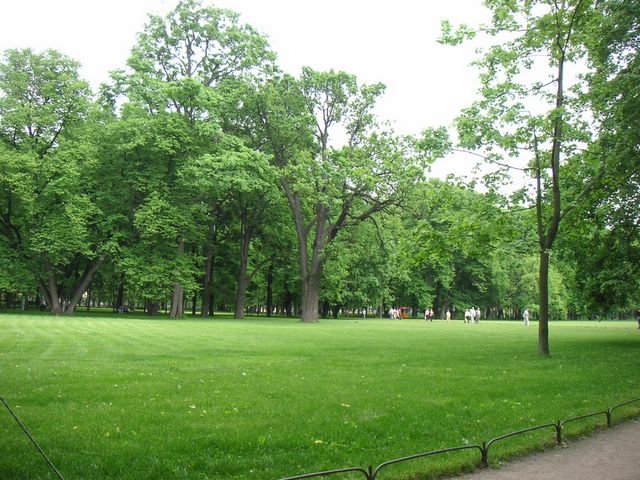
Mikhajlovsky Park

It's all really close together so I can chose the place that fit my mood best - Summer Garden, Michael Garden, Mars Field, etc.


Mojka river and the Rossi pavilion


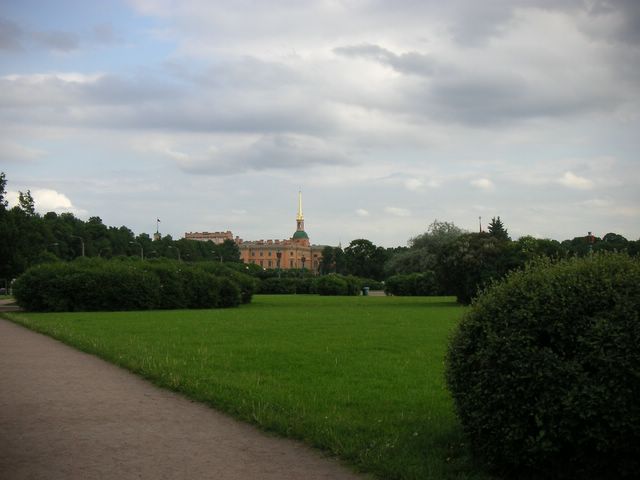
Mars Field, Mikhajlovsky Castle in the background

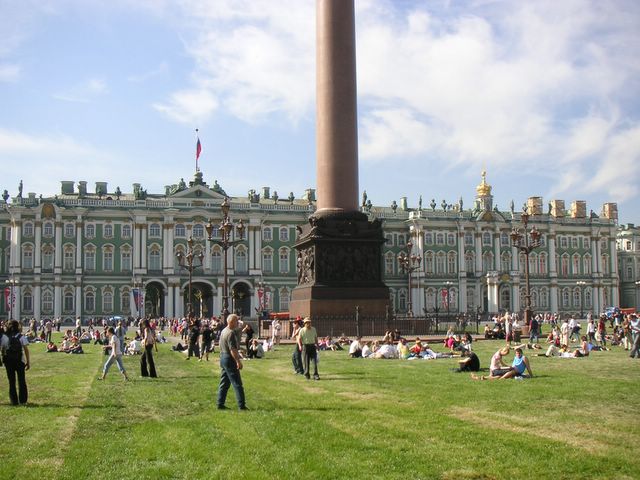
There are also some novel ways to add greenery to the city. On June 22, 2005 ">a grass lawn was created on the Palace square in St. Petersburg, Russia. Called "Grass of life", this is a memorial to the June 22, 1941, the day of the treacherous attack of the Fascist Germany on the Soviet Union. The grass symbolizes the victory of life over death, good over evil, peace over war.


Grass of Life on Palace square

Underneath the grass the square is paved with cobblestones. In the very middle of the grass raises the Alexander's column and in the background is the Winter Palace where the Hermitage is located (more photos).

If only we could do something about those goddamn cars. :(