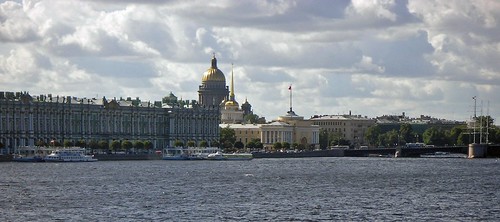
A view from the Peter and Paul fortress.

I can feel their magic power
On the left is a fat Georgian magic healer. In the middle a hippy-like clairvoyant that looks like a horse. And the host on the right. I can't believe that anyone is falling for that shit, but apparently some do, they all looked serious. Unbelievable, now I want to gouge my eyes out. I think I better to go read randi.org to ease the pain a bit.
Australian company Astrovision announced plans to provide real-time satellite video (first of Australia) with resolution down to 250 metres.
"Users [will be] able to select destinations and zoom in to as close as 60 metres and to as far out as 57,000 kilometres. ...Astrovision plans to launch five satellites to provide coverage of the globe over a decade."
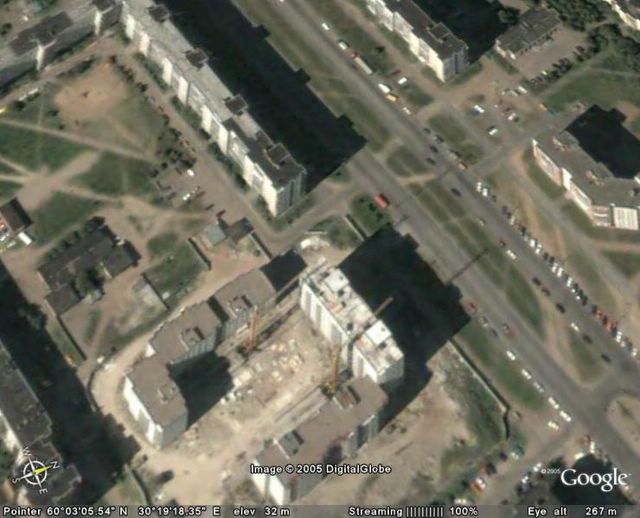
In the future more and more information about the world will be available to us indirectly (i.e. we won't see it with our own eyes) and this information will be multi-facetous, instant, customized and interactive.
In a sense, this is about gradually become omnipresent. Ultimately every human will be able to instantly know everything that is happening anywhere on Earth, know about every raindrop falling, every leaf trembling. Just like gods. Isn't it cool?
Posted to Future Wiki
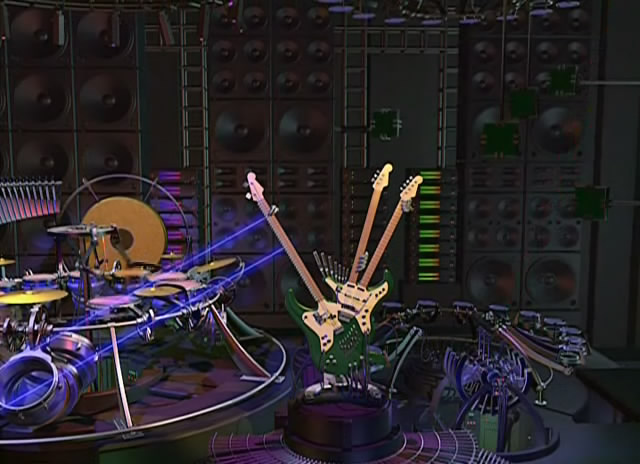
Future Retro
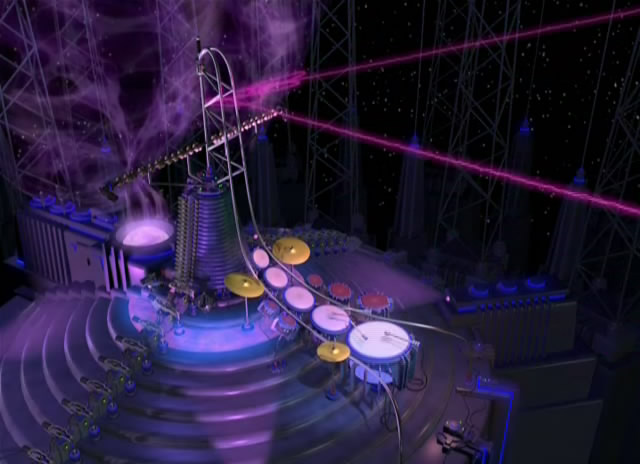
Harmonic Voltage
It's very original, both music and animation are very good. Short clips can be downloaded from the Animusic website. ATi has a real-time version of "Pipe Dream" and the video version. The DVD can also be downloaded from eDonkey network.
There are two distinct components in it.
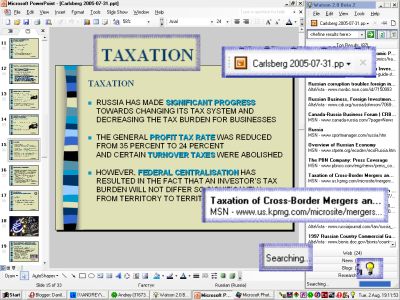
Watson gets the keywords from the document and searchs for them, showing the results in a side panel

The results are surprisingly relevant and often very useful
It saves you the hassle of carefully thinking about relevant search queries. The document you are editing becomes one big search query and the results (a few hundred links, usually) come almost instantly. So far I have only tried it on existing documents, but it should be interesting to try to use it while writing a new document, augmenting my knowledge and memory with the power of the Internet. :)
Obviously, in the future automatic context-sensitive search will become much more common. Computers will be presenting us with hints, ideas, reminders, based on what we are doing, reading, talking about. The amount of available data, including our photos, e-mails, posts, conversations, etc. is growing very fast, as well as the amount of relevant information online. In the past it made sense to perform research (originally a literature search, later a google search) before writing a paper or preparing a presentation. But increasingly this becomes redundant and useless, as the amount of useful and relevant information often far exceeds our need in it.
So it makes sense to pay less attention to getting all the information. The computer should just give us something and we will use it. This is how our memory works - we are not trying to produce a perfect recollection of our past actions or of school knowledge that we acquired - we simply use what our subconsciousness gives us. A good illustration to the expected future of search is in Charles Stross's Accelerando, where search agents are running on human exocortices.
My photos on Flickr: http://www.flickr.com/photos/91822944@N00/tags/caracas/
My photos on Flickr: http://www.flickr.com/photos/91822944@N00/tags/angelfalls/
My photos on Flickr: http://www.flickr.com/photos/91822944@N00/tags/canaima/
My presentation was entitled "Predicting mid-range global futures" and was mainly concerned with mocking futurists for their pathetic attempts at peering into the future. It was a hoot. :) Get it here: http://danila.spb.ru/papers/transhumanism/Danila TV2005.ppt. I presented before the Closing address by Nick Bostrom, but apparantly managed to make quite an impression on the tired delegates. It wasn't particularly controversial, but it was very direct and sincere at demonstrating why some of the existing "approaches" to predicting future are worthless. It was also quite emotional. :)
Links:
Finally, I succumbed to the exploding meme of GtD. I downloaded the book and will definitely start to implement this system in my life. I can already, by the 20th page of the book see how this applies to me, how the problems that I am facing can be probably solved using this methodology and how this is extremely relevant for me today. Was it a mistake to ignore the gtd acronym for several months? I don't know. But right now I seem to have the tools that I need - Note Studio for Palm looks perfectly adequate, in fact, more than adequate. Let's try and see.

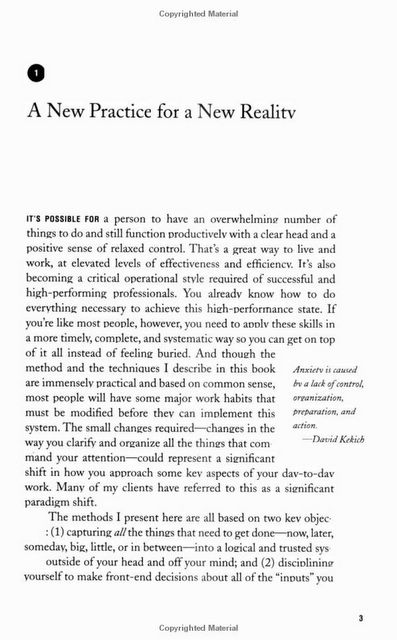
Cover and excerpt from "Getting Things Done"
Great, after reading Steve Pavlina's article "Overcoming Procrastination" I realised that my problem with procrastination is caused by the overwhelming scale of the projects due. However, Steve did not offer a good practical solution to that that could be actually used. Neither did many other articles and ideas - a complete and total system was missing. It seems that GtD is exactly such system.
Reading Mapping the Mind and listening to Biology And Human Behavior lectures made me better appreciate the metaphors that David Allen is using. When he talks about RAM in our brain, there are very real and tangible arrays of neurons that are firing in complex patterns, remembering something (what needs to be done) and reminding our conscious selves about it. May be they not so much use the space (after all, I doubt that all those things are stored in working memory), but they use the focus. They constantly activate the central processor area and place themselves in the working memory.
I wonder if my interest in getting OneNote, FreeMind and writing^H^H^H^H^H^H^Htyping things down was caused by the pressure from undone things, the subconscious desire to get them out of my mind... But that's only half of the story, the real deal are the actions - that's what GtD is about. This will certainly help me maintain my social life, keep up with the correspondents, etc.
This is really a great book and a great methodology. It would be an oversimplifcation to say that something is "the key" to it, but the emphasis on defining and choosing appropriate actions at appropriate times is clearly very important.
/me digs deep into "stuff", while following the magic GtD flowcharts.
OK, I spent most of the day implementing the GtD system. First, I was surprised how easily I agreed to make (or pledge to make) significant changes to the way I organise myself. The system seemed extremely logical and as easy to use as possible. Clearly, it takes into account the psychological aspects of how we deal with things and the benefits are there. I processed most of the stuff that was lying around loose, which there wasn't too much of, actually. I created appropriate categories for managing the actions on my Palm and started to populate them. I think I will need to spend some time working on this tomorrow and then on my Moscow trip as well. I hope it will help me actually start doing things.
Living in a big city can be really stressful sometimes. Fortunately, Saint-Petersburg has something to combat the stress, namely the great parks, avenues and embarkments.
St. Petersburg is the greenest of Russia's major cities. The statistics are impressive: Over 200 parks and gardens, plus over a thousand tree-lined streets and more than 700 leafy squares; and more than 2,000 hectares of greenery in total - or more than 56 square meters for each of the city's more than 4.5 million inhabitants. (more info)If one is not confined to the office, spending a few hours with a book (or a PDA) in a park can be really invigorating. My only complaint is the noise pollution from the cars - you can't get away from it.
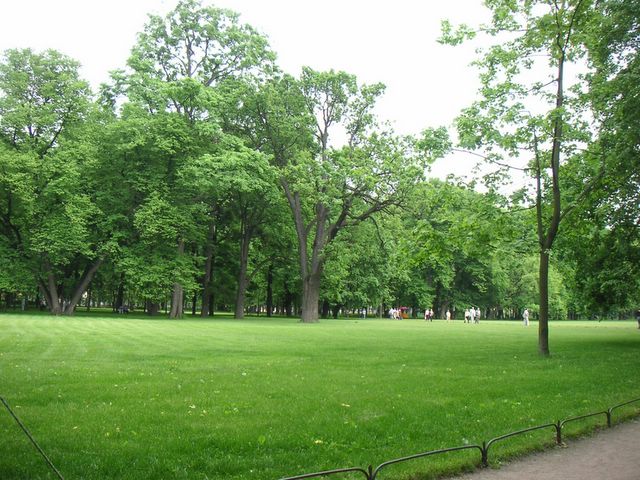
Mikhajlovsky Park

Mojka river and the Rossi pavilion
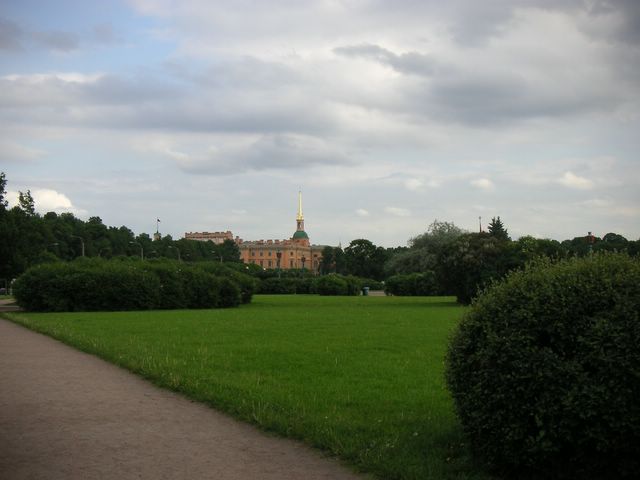
Mars Field, Mikhajlovsky Castle in the background
There are also some novel ways to add greenery to the city. On June 22, 2005 ">a grass lawn was created on the Palace square in St. Petersburg, Russia. Called "Grass of life", this is a memorial to the June 22, 1941, the day of the treacherous attack of the Fascist Germany on the Soviet Union. The grass symbolizes the victory of life over death, good over evil, peace over war.
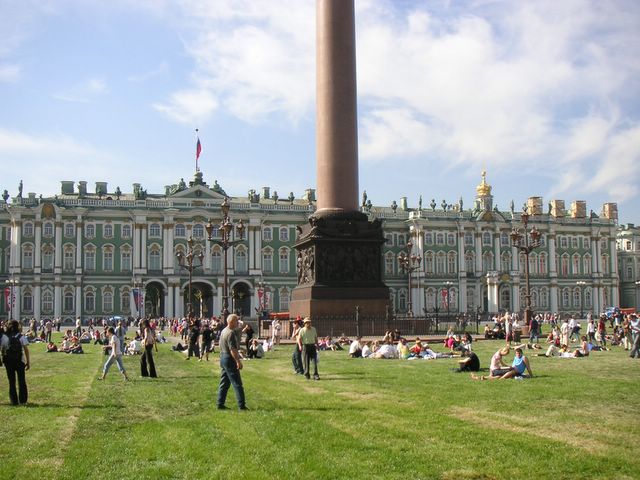
Grass of Life on Palace square
Underneath the grass the square is paved with cobblestones. In the very middle of the grass raises the Alexander's column and in the background is the Winter Palace where the Hermitage is located (more photos).
If only we could do something about those goddamn cars. :(
"Those who cannot remember the past are condemned to repeat it."
--George Santayana
The proletarian revolutions of the 20th century are not myths invented by evil totalitarian oppressors, they are not figments of our imaginations, and neither are they inconsequental riots of illiterate mobs. They are the result of oppressed rising against the oppressors. The motivation was pure and simple, to end the injustice, to create fair societies where people are free from tyranny and live worthy lives.
These societies were created - the tens of socialist states that arose all around the world, but few of them survive today. Cuba, Vietnam, North Korea. But just as the Soviet Union was unjustly and falsely labeled an evil empire, so are these last bastions of socialism. Now they are members of the Axis of Evil and disgusting false stories are spread about them. Tales of starvation and oppression are told by official imperialist propaganda and corrupt Western media. And of course the general public doesn't care about real facts, but prefers to get the truth nicely packaged and delivered on the evening news.
The reality is different, of course. As anyone, who cares to travel to North Korea or Cuba with open eyes and without prejudice, can see, people there live normal lives and the society cares for everyone, cares more than it does in most of the so called "developed countries". Their economies are weak, but socialism has nothing to do with it. All third world countries are poor because they can't exploit others like imperialist countries do. And history shows that planned economies do just as well or better as capitalist free market ones. Only they do it without flashy advertising, without elaborately packaged goods, without exuberant downtown shops. People simply have guaranteed jobs, free education, free medical care and pensions. They don't have BMW 7-series, though. Must be the inherently inefficient then...
In the meantime, the oppressed people all other the world, the sweatshop workers in Asia, the poor people exploited by multinational monopolies in South America, the unemployed minimum-wage slaves in the US, are all trying to deal with their problems. They are trying to organise, trying to limit the damage the MNCs can do, trying to have stronger labour laws passed, to limit corporations' rights to oppress and control. But for some reason they forget the lessons of the past and are afraid to speak openly (with the exeption of some remaining communist parties in the West) that socialism works, that revolutions are the answer, that totalitarian oppression sooner comes from a capitalist state than from a socialist ones and that democracy is a misleading label, the newspeak tool used to keep people from power.
We shall remember the lessons of the past. Let the deaths of the revolutionaries all over the world not be in vain.

Mars field in St. Petersburg - a monument to Russian revolutionaries

A monument to the revolutionary struggle of the Korean people in P'yŏngyang
The films by Sir David Attenborough are always amazing. After watching the Life in the Freezer I was hooked. The amazing images of the remote and inhospitable land, the beauty of penguins and other Antarctic creatures, captured on film with an intelligent commentary - the result is something you can't stop watching and can't help but be constantly amazed.

Penguins in Antarctica

A seal swimming under the thick ice.
I am watching The Private Life of Plants and it's fascinating how Sir David can always provide a fresh look at things in our oversaturated by nature documentaries age. I guess, I now need to watch all the "Life" series to get a good feeling and good understanding of what life really is... And then, then I would want to get away from the cities, from my fellow humans, get into wilderness and stay there (not forever, mind you), enjoying the nature, working on a tablet PC, reading books on a Palm. :) I suspect that connecting modern technology with a beautiful natural environment can do wonders to one's motivation and enjoyment of life.
While computers were getting smaller, one thing was getting bigger - comptuer displays. And no one doubts that it would be helpful to have even larger and higher resolution displays. Switching between applications using either Alt-Tab or Expose is never going to be as effortless as turning the head or just looking around. And to provide more and more real estate, computer displays have been steadily increasing in size and resolution (today more than 75% use 1024x768 and higher resolution) since the day one. So, of course, we will have bigger and better displays in the future, but the growth won't be just incremental — with e-paper, OLEDs, portable projectors, etc. the difference with today is going to be huge. But with a huge display the mouse input simply doesn't cut it anymore. You can't find a cursor on a giant screen, it takes some real effort to drag it across it, etc. A commonly proposed solution is to let the user use the hand. That's what we see in that overhyped movie Minority Report.

A hard to use, stupid and pointless interface from the unimaginative future of Spielberg's Minority Report.
There even is a real-life system currently in development by Raytheon based on the same ideas. Of course, the proponents of this approach forget that it's tiring to hold the hand in front of you for prolonged periods of time. They also rarely explain how exactly people would control the computers using their hands. Using hands to point to things is not energy efficient at all and using gestures a lot would destroy the wrists quickly. Tom Cruise manages to fake controlling the computer, waving expressibly to Schubert's "Unfinished" Symphony, but that won't work in real life just as easily.
Another problem is that, despite having a team of futurists that included Jaron Lanier and Kevin Kelly, the creators of the film couldn't come up with even a half-decent use case. I simply don't understand why John Anderton needed a 3 meter screen to play back three poor quality video clips. I can do it on a 17" CRT display much better, thank you very much. :)
Of course, this is not to say that big displays are useless or that hands can't be used to control them. But before that can happen we probably need to change the dominant GUI paradigm.
If a big screen is used to display a single (at most a few) object, such as a large map or a video clip, we don't need hands. Projectors work just fine today, controlled from laptops with touchpads. We would need hands only if the "control density" of the computer output (that is the number of possible operations you can do per square metre) drastically increases. If you need to manipulate parts of the output (such as tap a house on a map for more information) or manipulate (move, arrange, sort, etc.) a large number of objects quickly and visually, then hand control starts to make sense.
A much better fictional depiction of this scenario is the VR control room in Zion in the Matrix Reloaded.

Storyboard from the Virtual Control sequence
The concept art created for the Matrix actually makes much more sense than that Minority Report nonsense. In the above image we see different types of information displayed efficiently, because:
The actual shots from the film look even cooler and actually make a huge step forward in terms of usability. If there ever was an uber-sexy GUI, that was it.

Virtual Reality interface in Matrix Revolutions
The key change that we see is that the flat "sheets" are gone. Now the information is availble in separate "chunks", groups of individual elements that can be moved (using a finger to drag them) around a vertical 2D space. This eliminates useless filler and allows the user and the computer to position information much more efficiently. As a result, this removes the problem of stacking (all information is instantly visible) and frees the background for 3-dimensional models of real-world objects, such as hovercrafts, tunnels and cannons. Also, ergonomic split keyboards neatly compliment the on-screen controls.
To effectively use such interfaces, the computer GUI itself needs to be redone from scratch - we need to go even earlier than Alto, all the way to NLS and start from there again. :) The future GUI needs to combine content-based structure with visual structure. We already have content-based structure — lists, menus, etc. But the visual structure is almost absent. One example is the cluttered Windows desktop, where users arrange icons according to their preferences. Another example are toolbars in applications such as Photoshop (but it's tools, not the information, that is arranged). But the most interesting field that is currently emerging are the graph-based interfaces. There aren't many examples yet, but it looks awfully suitable for our future needs. The complexity of managing the growing amounts of information, the complex categorization schemes and the interrelations between different pieces of data.
Some existing examples of this are:


1) Liveplasma service for graphically navigating the world of movies and music; 2) FreeMind mindmapping application for organising information structurally, but navigating it visually too; 3) CmapTools for concept map modelling and collaborative online editing.
Interestingly, the interface in the Matrix can actually serve as an inspiration not only on how we can manage the "chunks of information", but also to how the display itself may work. Why use a 3-metre plasma or an OLED display when you can have a virtual one? And we won't need to plug-in into Matrix in order to get it. Augmented reality may be a partial answer to the challenge of creating large displays, where the controls such as in the Matrix example are overlayed on the real world. Of all technologies capable of creating virtual 3d objects that the user can interact with this one actually looks the most promising. Having glass surfaces, walls and other screens may not be necessary, when we can just hang the virtual objects in front of the user?
Since I didn't have much of an idea of what sousveillance is going to be used for, I couldn't really understand how it fit withing different parts of the political compass. After some deliberation with a cup of tea, though, I got a couple of ideas. This may not make much sense and may be ultimately wrong, but that's how I see it now. This applies mostly to "inverse surveillance" sousveillance.
First, in a liberatrian society (if such can exist) people definitely have it the easiest to justify sousveillance - the individual just has the right to do it and noone should be able to limit his freedom. Liberatrians won't have much use for it, though, since the libertarian government doesn't actually care one way or the other about anything its citizens may record.
People in socialist countries might be luckier. While the critics may remember the tightly controlled xerox machines and limits on free speech, it should be noted that only subversive speech was unwelcome (and of course, spying in secret cities, military bases, etc.). The Soviet government and the soviet society in general welcomed communications and feedback, from wall newspapers to letters to Pravda and the Central Committee. One can't tell that for certain, but I suspect that the Communist Party of the Soviet Union would not particularly mind e-mails (even MMSed) with complains and suggestions with photos and videos attached. :)
But still, I can see only a limited use for sousveillance in a socialist state. It looks to my eyes that sousveillance would benefit the most people living in oppressive, but democratic (theocracies and military dictatorships don't qualify) societies. That is, people living in ordinary Western capitalist democratic countries, such as the US or many Western European countries. In these countries there is plenty of material that is:
To look at the sousveillance in general (not just at inverse surveillance), we can consider the deeper differences between libertarians/right and socialists/left (not the only dichotomic division, but let's tackle this first). Very simply put, libertarians consider the individual most important, while socialists consider the society most important. It's obviously a crude simplification, but without the society there is little use for personal recordings, except for the functional (memory aid). The potential of sousveillance is utilized only when we can share the recordings with others, be it through glogging or something else. Obviously, the possibilities are largely untapped at this point, but there must be a lot of ways that the experiences, knowledge, etc. could be shared through this. This application doesn't look very political though, more social and philosophical. Clearly it leads to more openness, tighter social connections, better understanding, etc., just like open communications in general. Sousveillance doesn't so much empower the individual as it strengthens his connections with others. This is clearly something that, for example, Soviet thinkers and artists in 1920s and 1930s would be extatic about. :) So I guess one can make a case that sousveillance is very compatible with leftist ideas.
The lies about Soviet Union are already entrenched in our collective mind. We don't remember what was happening in 1930s and mostly base our judgements on the lies spread later. That's why it's so important to read unbiased historic personal accounts to understand how deep and detestable these lies are.
Two excellent books that are best suited for this are Return From the USSR by Andre Gide (Amazon) and Moscow, 1937 by Lion Feuchtwanger (Amazon). Both these writers were not avid supporters of communism, both were honest and widely respected by their contemporaries, both were invited to Soviet Union and both had the ability to travel around the country and see everything without, not just the facade, without any pressure or control. Both include some criticism (Gide criticises more), but both admit that Soviet Union was a widely successul majestic country populated by truly happy people that loved their country, were happy to work to make it better and sincerely believed that socialism (communism) is the right way to go and saw everyday the most impressive results. They had the reason to be proud of living in the Soviet Union and people all over the world had the reason to look at Soviet Union for hope and inspiration.
It is a simple fact, Soviet Union was the best and the most forward looking country in the world. Sadly, it collapsed under the attacks from outside and from within, but it's still the best model society we ever had and the best way to build a truly free and happy society is to base it on the Soviet model.

For the people by the people - not for dictators, not for the Party, not for the capitalists or for the monarchs anointed by god, but for people. The goal was to build the just, prosperous, happy and free society and everyone shared that goal.
As of 2005 we are on the threshold of realism in games. It is finally possible to simulate certain aspects of reality in real time and with sufficient precision to declare it an accurate simulation overall.
For example, the Forza Motorsport racing simulation for Xbox is physically realistic. It is mostly on par with reality, even though it's not indistinguishable yet. To achieve this, programmers from Microsoft Game Studios take into account between 3000 and 10000 variables and simulate all aspects of driving, running the simulation at 240 ticks per second. For Race Against Reality Popular Science asked a veteran gamer and a professional race driver to extensively test drive both real cars and their virtual prototypes. The conclusion was that the game simulation is accurate.
Similar level of realism is available for the flight simulators, again from Microsoft. Some simulators are so realistic that pilots are allowed to log the virtual hours just like the real ones.
However, these simulations are not completely realistic yet. There are still things that can be improved though before we have perfect VR.
The video-realistic graphics based on general-purpose stable rendering systems (i.e. no more custom-made rendering engines for every new project) will come around 2010-2015. The programmatic sound may be delivered somewhere between 2015 and 2025. Global physics may be done sufficiently well around 2015-2020. The realistic simulations of all senses may come somewhere between 2015 and 2025. Sufficiently good non-human and domain specific human AI (i.e. for an NPC that can realistically perform in a narrowly defined context) may come somewhere about 2015-2020. Good human-level AI (in the context of video games it's a companion that you can interact closely for many hours in a variety of situation, including free-form talking) is a more complex problem and will probably not be achieved until the 2030s.
Still, we have already entered the realm of virtual reality. In some aspects, although not in all, virtual environments are already as good as real ones.

Health condition of pregnant women, mothers and children
1 - births complicated by anemia, %; 2 - children born sick, %; 3 - mothers with anemia, %

Income inequality

Construction of preschools, thousands of kids accomodated

Consumption of fish and fish products, kg per capita per year

Deep prospecting drilling for chemicals, mineral water and thermal water resources, thousands meters
This destruction of a country was started under the banner of greater economic efficiency, higher incomes, bigger opportunities for people. Economic efficiency, indeed... After the initial shock the destruction continued under the banner of greater freedoms, better democracy, opening the society. How convinient that these things can't be measured and we have to rely on the claims of ardent supporters of the regime to believe that we are in fact getting all these benefits.
And when someone does measure these benefits, we are in for a few surprises too. Corruption Perception Index places Russia 90th, next to Mozambique and Tanzania. In the Index of Economic Freedom it is placed 124th, around Rwanda and Cameroon. And in Human Development Index it is ranked 57th, right next to Libyan Arab Jamahiriya and Antigua and Barbuda. Russian reforms are a crime agains humanity and there can be no justification for what was done to the Soviet people.

